


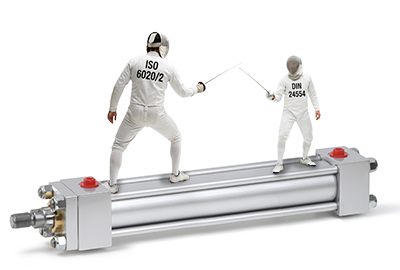
ISO 6020/2 and DIN 24554 describe the same 160 bar hydraulic cylinder with unified mounting dimensions. DIN 24554 is the historical German national standard; with international harmonization it was superseded by ISO 6020/2, which today is the active reference for new designs. The residual difference that can block a replacement lies not in the overall dimensions but in one precise detail: the thread of the rod end, which does not coincide between the two standards. Anyone who has to replace a cylinder on an older German machine, or reorder from a drawing that still cites the DIN designation, therefore needs to check just one point, the rod end, and to know how to specify it in the order.
ISO 6020/2: the active reference for 160 bar cylinders
ISO 6020/2 defines the mounting dimensions of 160 bar hydraulic cylinders: overall dimensions, mounting configurations (ME5/ME6 flanges, MP1/MP3/MP5 pivot mountings, MT1/MT2/MT4 trunnions, MS2 feet, MX plate mountings) and interfaces to the machine. Its purpose is interchangeability: two compliant cylinders, even from different manufacturers, fit the same mountings with the same overall dimensions. The Conforti CD/DK/MD ISO 6020/2 tie-rod series cover bores from 25 to 200 mm, with an operating pressure of 160 bar, a test pressure of 240 bar and strokes up to 4000 mm. For higher pressures the standard changes: heavy-duty applications up to 250 bar are covered by ISO 6022 (DP series), a separate scope that should not be confused with the comparison discussed here.
DIN 24554: the historical German standard, superseded but still found on drawings
DIN 24554 is the German national standard that, before international harmonization, defined the mounting dimensions of 160 bar hydraulic cylinders: the same purpose as ISO 6020/2, of which it is in effect the forerunner on the German market. It is no longer the active reference, as its content has been merged into the ISO framework, adopted in Germany as DIN ISO 6020-2, but it is still very present in practice: drawings, bills of materials and specifications of German machines still in service cite the DIN designation.
The differences that affect the choice
In terms of overall dimensions and mountings, the two standards are operationally equivalent: since they derive from the same dimensional system, an ISO 6020/2-compliant tie-rod cylinder meets the mounting dimensions expected by a machine designed on a DIN 24554 basis. The point where the two standards diverge in a functionally relevant way is the thread of the rod end. The male thread specified by DIN 24554 does not coincide with the ISO 6020/2 standard thread: a cylinder ordered "to ISO" may therefore fit perfectly in the machine and then fail to screw onto the existing rod-end accessory (whether a clevis, a spherical rod eye or a threaded tie rod). This is the typical retrofit mistake: the check focuses on centre distance and mountings, which turn out to be correct, and the non-conformity only emerges in the workshop when the rod is connected. That is why the Conforti catalogue provides, among the coded rod ends, the SL option (DIN 24554 male thread), alongside the ISO standard, the SF female thread and the ST floating joint; for the SL end, the same rod-end accessories of the range are available, with spherical rod eye or clevis with pin. Compatibility with the DIN world, in other words, is a catalogue configuration option: it is resolved with an option code in the ordering code, without leaving the standard or resorting to a cylinder made to drawing.
Spare parts and documentation: what changes in how they are managed
The choice of reference standard has management implications. Specifying ISO 6020/2 means aligning with the active international reference: datasheets, CAD models and spare parts speak the same language in every market, and the cylinder can be reordered without ambiguity even years later. Keeping only the DIN 24554 designation in the bill of materials, by contrast, ties the documentation to a superseded standard: it works as long as the supplier knows how to interpret it, but it adds a translation step to every reorder. The critical point is the rod end: if the rod-end accessory on the machine remains the original one, the thread must match, so the SL option (DIN 24554 male thread) must be specified; if the accessory is replaced as well, it is better to switch to the ISO standard and settle the matter there. In both cases you remain within the scope of the catalogue options.
New design: which reference to adopt
On a new design the answer is clear-cut: the reference is ISO 6020/2, the active international standard. Specifying it ensures interchangeability between suppliers, consistent documentation and availability of spare parts in every market, including Germany, where DIN ISO 6020-2 adopts the same framework. Citing DIN 24554 in a new specification adds no technical requirement: it only adds a superseded designation.
Operational comparison of the two standards from the point of view of anyone who has to select or replace a tie-rod cylinder.
Aspect | ISO 6020/2 | DIN 24554 | Notes |
Status of the standard | Active standard, international reference (adopted in Germany as DIN ISO 6020-2) | Historical German standard, superseded by ISO harmonization; still cited on drawings and bills of materials of machines in service | New designs and specifications are written to ISO 6020/2; the DIN designation is found in retrofits |
Scope | Mounting dimensions of 160 bar compact cylinders | Mounting dimensions of 160 bar cylinders (same purpose, German market) | Same standardized object: the comparison concerns designations and details, not two different product families |
Rod end (male thread) | ISO 6020/2 standard thread (KK dimensions in the catalogue for each bore/rod combination) | DIN 24554 male thread, different from the ISO standard | This is the critical point for interchangeability: in the Conforti catalogue it is specified with the SL option; spherical rod eyes or clevises available for both versions |
Pressures | Operating 160 bar · test 240 bar (every cylinder tested to ISO 10100) | The pressure values of the tie-rod range apply to both designations: they are not a criterion for choosing between the two standards | |
CD/DK/MD series — ISO 6020/2 · DIN 24554 tie-rod cylinders
The CD/DK/MD ISO 6020/2 tie-rod series (bores 25–200 mm, operating pressure 160 bar, strokes up to 4000 mm) declare compliance with both standards in the catalogue: mountings with dual ISO/DIN designation in the ordering code, and rod end also available with DIN 24554 male thread (SL option), with spherical rod eyes or clevises for both versions. Every cylinder is tested to ISO 10100 before delivery.
CAD configurator: compatibility is specified at the ordering stage
In the Conforti CAD configurator, mounting and rod end are fields of the ordering code: anyone starting from a DIN drawing can build the configuration and download the CAD model to check the overall dimensions, before requesting a quote.