

 Italiano
 Deutsch
 English
 Français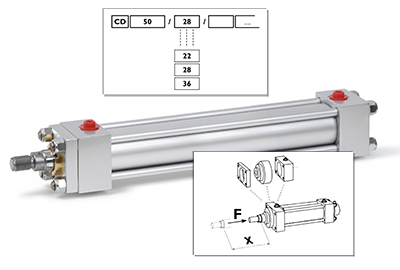
When integrating a hydraulic cylinder into a new project, you need to analyse and evaluate the different requirements in order to define the dimensional and functional characteristics of the product to be used. You will then need CAD drawings, complete technical data sheets, and the assurance that the dimensions correspond exactly to your specifications. Traditionally, this process required contact with suppliers, waiting for quotations, and repeated exchanges that could take days. The Conforti hydraulic cylinder CAD configurator eliminates this waiting time, allowing you to follow a guided product selection process — with real-time feasibility and compatibility checks — and to automatically generate all the technical documentation in a matter of minutes. 2D drawings in DWG and DXF format, 3D models in STEP, IGES, SAT and X_T formats, and complete PDF technical data sheets. The files are ready to be imported directly into your mechanical assemblies, significantly accelerating development timescales.
Let us look in detail at how to make the best use of the CAD configurator.
One configurator, two complementary services
The configurator guides you through a series of successive choices that automatically validate the compatibility between the various selected options, preventing specification errors. Two versions are available on the website www.confortinet.com. In the LUX guided design mode, you can enter the operating parameters — such as push force, pull force, and stroke — and you will be guided step by step towards the most suitable choices for configuring the product that best meets your requirements. The part number composition service helps you obtain the code for the required cylinder. In both cases, you can customise the cylinder dimensions, add options and variants, and download the CAD and PDF documentation.
Selecting the product family
The first fundamental step consists in choosing the cylinder family most suited to your application. ISO 6020/2 tie-rod cylinders represent the most versatile solution for standard industrial applications, offering pressures up to 160 bar with bores from 25 to 200 mm. Their four-tie-rod configuration facilitates maintenance and ensures operational reliability.
For more demanding applications requiring very long strokes or where significant radial loads are present, select ISO 6022 cylinders. These cylinders deliver superior robustness thanks to the extensive bronze guide bushings for both rod and piston, making them ideal for sectors such as heavy metalworking or steel plant operations.
If your application requires precise position control, you can opt for versions with magnetic sensors or magnetostrictive position transducers, which transform the standard cylinder into a servo-cylinder.
You can also obtain drawings and technical documentation for compact cylinders, rotary actuators, and accessories for ISO hydraulic cylinders.
Defining the key dimensions
Once the family has been selected, specify the three key dimensions: cylinder bore, rod diameter, and required stroke. The configurator immediately displays the available combinations. For each bore, generally 2–3 different rod diameters are available, allowing you to optimise the ratio between push force and extension speed.
Choosing the mounting style
The mounting type determines how the cylinder will be fixed to your application. The configurator presents all options provided for by ISO standards with immediate graphical representations. Front or rear flanges offer rigid fixing on flat surfaces, while pivot mounts with spherical bearings allow articulated movement, absorbing misalignment.
Foot mounts are ideal for cylinders installed on baseplates, while extended tie rods allow special fixing arrangements without additional components. For each type, the system displays the complete envelope dimensions, allowing you to immediately verify compatibility with the available space in your project.
Configuring oil ports and options
The oil ports can be positioned in various configurations on the end cap. Variants are available to optimise accessibility based on the layout of your hydraulic circuit. You can choose between GAS ports in accordance with ISO 1179-1, with dimensions proportional to the required flow rate.
Adjustable cushioning can be configured on the front end cap, the rear end cap, or both. This feature is essential for dampening end-of-stroke impact in high-frequency cyclic applications, extending cylinder service life.
If your application operates at high speed or with strokes exceeding 2,000 mm, consider adding the bushing drain option. This prevents fluid accumulation between the wiper and the seal, connecting the bushing directly to the tank.
Customising Materials and Seals
The rod material must be selected based on the operating environment. Chromed CK45 steel offers excellent general-purpose performance, while heat-treated steel provides better resistance to impulse loads. For corrosive environments, opt for chromed stainless steel, while in the presence of particularly aggressive agents, Nikrom ensures superior durability.
Seals are a critical element. Select polyurethane configurations for standard applications, NBR+PTFE for elevated temperatures up to 80°C, or Viton for compatibility with aggressive fluids and temperatures up to 150°C.
Downloading the technical documentation
Once the configuration is complete, the system simultaneously generates all the necessary files. The 2D drawing in DWG or DXF format contains complete views with dimensions, port positions, and mounting details. The 3D models in STEP, IGES, SAT, or X_T format are ready for import into the most widely used parametric software packages, allowing immediate interference checks.
The PDF technical data sheet lists the complete part number, all dimensions, materials, operating pressures, and seal specifications. This document forms the basis for requesting precise quotations or placing orders through the PRISMA e-commerce platform. Another very useful feature of the PDF document is the presence of a QR code that provides access to all the specific data and details of the configured product.
The configurator integrates with Conforti technical support, which remains available for particularly complex applications. This combination of digital automation and human expertise ensures optimal support for every design requirement. To discover all the customisation possibilities for hydraulic cylinders, visit the dedicated section on the website.
© 2026 Conforti Oleodinamica