


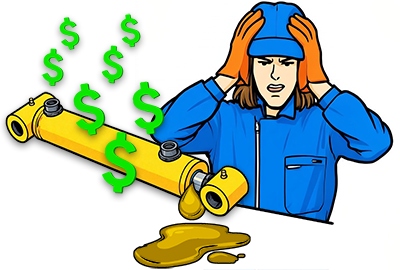
In today's industrial landscape, where margins are thinning and competitiveness is measured in fractions of efficiency, the choice of hydraulic components represents a strategic decision that goes well beyond comparing list prices.
A hydraulic cylinder purchased at a low price may appear to be a saving, but this can rapidly turn into a loss when the component fails during a production cycle.
The reality of unexpected machine downtime reveals an economic equation that is frequently underestimated in purchasing decisions. While the list price is immediately visible and quantifiable, the cost of machine downtime remains hidden until the moment it materialises, generating losses that can exceed the initial saving many times over.
This dynamic transforms what appeared to be a cost-effective purchase into an economically unsustainable choice.
Calculating the Real Cost of Machine Downtime
The cost of industrial machine downtime is made up of tangible and hidden elements that require structured analysis. Lost production is the most immediate component. But this is only the tip of the iceberg.
Fixed costs continue to accrue even during downtime: idle labour, active utilities, machinery depreciation continuing regardless of productivity. To these must be added emergency interventions involving premium rates for overtime labour, urgent shipment of replacement components, and potential contractual penalties for late deliveries to customers.
The most insidious dimension concerns long-term indirect costs. Poorly managed machine downtime erodes customer confidence, which may lead them to evaluate alternative suppliers to secure greater reliability. A company's reputation, built over years of work, can sustain significant damage from a single critical incident that compromises an important delivery.
The Technical Differences That Determine Reliability
A quality hydraulic cylinder is distinguished from an economy component through design and material choices that directly affect operational service life. The chromed rod is an emblematic example: in quality ISO 6020/2 cylinders, the values associated with hard chrome plating must meet defined standards, as must those related to surface roughness. In economy components, these parameters are frequently reduced to contain costs, compromising wear resistance.
Bronze guide bushings constitute another differentiating factor. A piston with extensive bronze guiding surfaces, as in DP series cylinders, withstands unforeseen radial loads without generating premature wear, whereas economy solutions using reduced guides or alternative materials show early deterioration in the presence of even minimal misalignment. This difference becomes critical in applications with long strokes or variable loads.
Seal materials represent perhaps the most decisive choice for long-term reliability. High-quality NBR-PTFE seals maintain sealing performance for millions of cycles, while economy compounds degrade rapidly, causing leaks that require unscheduled maintenance shutdowns. The cost difference between premium and economy seals may be a matter of a few euros, but the impact on operational service life is measured in years.
Testing Processes: Investment or Cost?
Conformity with ISO 10100 for hydraulic cylinder testing represents a dividing line between reliable components and products of questionable quality. All Conforti cylinders are subjected to test pressures of 1.5 times the nominal pressure, verifying not only sealing integrity but also the absence of structural deformation.
Systematic testing of every individual component, with results recorded in quality management systems, enables complete traceability and identifies potential defects before the product is delivered. This process requires investment in test equipment and production time — elements that economy manufacturers frequently eliminate to reduce costs.
Internal leakage tests ensure that the cylinder will maintain energy efficiency over time.
Verifying the absence of even minimal internal leakage makes it possible to guarantee that the rod position is held at a fixed and defined point.
When Saving Becomes a Loss
Consider a real-world scenario: a steelworks with a press using four front-flange cylinders. The price difference between premium and economy cylinders can be significant.
If, after only a few months of service, one of the economy cylinders develops a rod seal leak, the repair intervention requires several economically impactful activities:
1 — plant downtime hours for disassembly;
2 — seal replacement and reassembly;
3 — hours of lost production;
4 — cost of the urgent maintenance intervention and replacement seals.
The total cost of a single failure reaches significant figures, often greater than the initial saving. If we consider that higher-quality components would have operated without issue for years under the same conditions, the economic equation becomes unambiguous. The "economy cylinder" has proven to be the most expensive choice possible.
Spare Parts Availability: A Frequently Overlooked Factor
A frequently underestimated aspect of the economic evaluation concerns the accessibility of replacement components. Quality manufacturers maintain well-stocked inventories of seals, bushings, and spare parts with standardised part numbers that guarantee interchangeability and immediate availability. This logistical organisation represents a significant investment that is reflected in the price of the original component.
When an economy cylinder requires maintenance, sourcing compatible spare parts can take days or weeks, dramatically extending machine downtime. In many cases, non-standard dimensions or the absence of precise technical documentation make complete cylinder replacement necessary, cancelling out any initial saving and adding the costs of prolonged downtime.
Standardisation in accordance with ISO regulations ensures that seal grooves, housing diameters, and thread forms follow precise specifications, permitting rapid replacement even years after purchase. This interchangeability represents a form of insurance against prolonged downtime, the value of which becomes apparent only when it is needed.
Strategies for Minimising Risk
Optimal management of a cylinder fleet in an industrial plant requires a strategic approach that balances initial investment against long-term operating costs. The choice should begin with an analysis of component criticality: cylinders operating on machines in difficult-to-access positions always warrant the highest quality available.
A preventive maintenance programme, with scheduled inspections and seal replacement at defined intervals, extends operational service life and dramatically reduces unexpected failures.
Partnership with manufacturers offering qualified technical support and immediate spare parts availability represents a value that exceeds any saving on a price list. A failure resolved in 48 hours rather than two weeks can make the difference between a manageable inconvenience and an operational crisis with impacts on customers and company reputation. Thanks to its production process organisation, a reliable partner such as Conforti guarantees a 48-hour delivery option for replacement cylinders.
Looking Beyond the List Price
The cost of machine downtime due to hydraulic cylinder-related issues represents the true unit of measure for evaluating the economic viability of a component. While the purchase price is visible and immediate, long-term operating costs determine the real impact on the company's bottom line. A quality cylinder operating without issues for years generates a net saving that exceeds that of economy components which may require intervention after only a few months of use.
Total Cost of Ownership analysis must consider not only the direct costs of maintenance and spare parts, but also production losses, the impact on planning, emergency costs, and the effects on customer relationships. In this broader perspective, investment in quality components proves to be the most economically rational choice.
For technical guidance on selecting the most suitable hydraulic cylinders for your applications, or for personalised advice on preventive maintenance management, please contact our specialists.
© 2026 Conforti Oleodinamica