


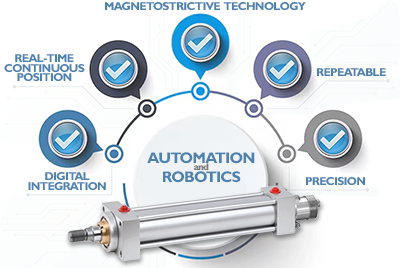
In modern industrial automation, the choice of actuation system is a decision that directly impacts the quality of the finished product, line productivity and the complexity of integration with control systems. In this context, hydraulic cylinders are still perceived today by some designers as a "traditional" technology, suited to power but less to precision. This is a perception that deserves to be reviewed with data in hand.
New-generation hydraulic servo cylinders combine the typical force of hydraulics with repeatability levels in the order of microns, native communication protocols compatible with PLCs and industrial supervisory systems, and a constructive robustness that electromechanical systems struggle to match in harsh environments. This article explains how position control works in hydraulic cylinders, which components determine the actual precision, and in which automation and robotics applications this technology expresses its best.
Two levels of control: position detection or continuous positioning
When talking about hydraulic cylinders for automation, it is useful to immediately distinguish between two approaches to position control, because they respond to very different application needs.
The first approach, the simplest, is position detection at discrete points. It involves precisely identifying the moment when the piston reaches one or more predefined positions along the stroke, typically the end of stroke or an intermediate position. This result is obtained with cylinders equipped with magnetic sensors: the piston is magnetic and, when passing in correspondence with an external sensor attached to the cylinder body, closes the electrical circuit and sends the signal to the control system. These are compact, economical and reliable solutions, ideal for repetitive ON/OFF cycles such as clamping, ejection and sequential handling.
The second approach, suited to more sophisticated control cycles, is continuous and absolute positioning of the rod at any point of the stroke. Here, servo cylinders with magnetostrictive linear position transducers come into play: a non-contact measurement system that determines the absolute position of the piston.
The magnetostrictive transducer: how it works and why it matters
Magnetostrictive technology is the heart of position control in advanced servo cylinders, and it is useful to understand its operation to appreciate its real advantages in an application context.
The principle is based on the interaction between an electrical pulse traveling through a ferromagnetic waveguide and the magnetic field generated by a magnet integral with the cylinder piston. This interaction produces a mechanical wave (the Wiedemann effect) whose propagation time, measured precisely, determines the absolute position of the piston at every instant. The measurement is absolute, which means that no zeroing is required when the system is switched on: the transducer always and immediately knows the correct position of the rod, even after a power interruption.
The system works without physical contact between the moving parts of the transducer and the measurement waveguide, which eliminates mechanical wear and guarantees a long service life even in applications with intensive cycles. IP67 protection makes it suitable for use in industrial environments with the presence of dust, coolants and vibrations.
From the point of view of integration with control systems, Conforti hydraulic servo cylinders, available in the TD and TK series (ISO 6020/2 tie-rod), TH and TX (ISO 6020/2 with counterflanges) and TP (ISO 6022 for heavy-duty applications), support a wide range of output signals. In analogue mode, 0-10V and 4-20mA outputs are available; in digital mode, the transducer supports SSI, CANbus, DeviceNet, Profibus, EtherCAT, EtherNet/IP, PROFINET and POWERLINK. This is the same list of protocols as the main PLCs and industrial supervisory systems, which greatly simplifies integration without additional adapters.
The constructive factors that determine real precision
The transducer provides the measurement, but the actual positioning precision also depends on the mechanical behaviour of the cylinder during movement. Two phenomena in particular can compromise the quality of control even in the presence of a high-resolution transducer: internal leakage and stick-slip.
Internal leakage is the passage of fluid between the piston chambers, which reduces the effective force and makes the cylinder's behaviour less predictable, especially at low speed. To minimise it, servo cylinders intended for position control are built with tighter tolerances and high-seal gaskets specifically designed for this application.
Stick-slip, literally "stick and slip", is instead the irregularity of movement that occurs when the static friction between the seals and the rod is significantly greater than the dynamic friction. At low speed, the cylinder tends to remain stationary (stick) and then snap forward (slip) as soon as the hydraulic force exceeds the static threshold, creating a stepped movement profile instead of a linear one. To avoid this phenomenon, servo cylinders are equipped with low-friction seals, which guarantee a smooth transition between static and dynamic friction, optimising behaviour at both high and low speeds.
A further element that directly affects repeatability is the volume of oil between the valve and the cylinder. The smaller this volume, the faster and more precise the system response to commands: every pressure variation translates almost immediately into rod movement, without the residual compressibility of a long section of piping. For this reason, servo cylinders can be equipped with integrated CETOP bases, which allow direct mounting on board the cylinder of proportional solenoid valves, ON/OFF valves or servo valves compliant with the ISO 4401 standard. The reduction of the interposed volume significantly improves response times and the hydraulic stiffness of the control system.
Applications in automation and industrial robotics
The technical profile just described translates into concrete solutions for a series of applications where the combination of high force and precise position control is an essential requirement.
In automated assembly lines and in stamping and deep-drawing presses, servo cylinders allow precise control of the position of the blank holder or tool during the working cycle, guaranteeing the dimensional repeatability of the parts produced cycle after cycle. Unlike a fixed-pressure system, position feedback control allows automatic compensation for material variability or tool wear.
In CNC machine tools, hydraulic cylinders with magnetic sensors find application in workpiece clamping and locking systems, where confirmation of the correct position before the start of machining is a safety as well as a quality requirement. The MD series tie-rod cylinders with magnetic sensors, with stainless steel barrel and magnetic piston, are designed specifically for this type of integration.
In robotic handling systems where a linear joint must develop forces high forces while maintaining veri high positioning repeatability, hydraulic servo cylinders represent a solution that hardly finds direct equivalents in electrical systems, which at those forces require gear motors of significant size and cost.
In automation for heavy-duty applications, foundries, steelworks, forging presses, where the presence of high temperatures, vibrations and contaminants makes the adoption of delicate electrical systems problematic, the TP series ISO 6022 servo cylinders, tested at 375 bar and equipped with bronze guides for the management of radial loads, operate in conditions that would be critical for other types of actuators.
For applications where space is a constraint and the required force is limited, compact cylinders with magnetic sensors, available in aluminium version (MP series) or steel (RQ series), offer a modular response that is easy to integrate into moulds, special equipment and clamping systems. The RQ series is equipped with proximity sensors to allow end-of-stroke reading.
Hydraulic precision and digital integration: a mature combination
The idea that hydraulics is a brute force technology, suited to power but not to the finesse of control, belongs to an era when position transducers were approximate and industrial communication protocols were not yet standardised. Today's servo cylinders respond to a completely different paradigm: they are high-technology components that integrate precision mechanics, advanced sensors and native digital communication protocols.
For a designer of automation systems, the correct evaluation is not "hydraulic vs. electromechanic" in the abstract, but which technology best responds to the specific requirements of the application in terms of force, speed, precision, operating environment and total life cycle cost. In many scenarios, high forces, harsh environments, long strokes, the balance favours hydraulic cylinders with a margin difficult to bridge.
To explore in depth the technical specifications of the available series or to receive support in choosing the most suitable servo cylinder for your application, we invite you to explore the complete range of Conforti hydraulic cylinders or to contact our technical office.
© 2026 Conforti Oleodinamica