


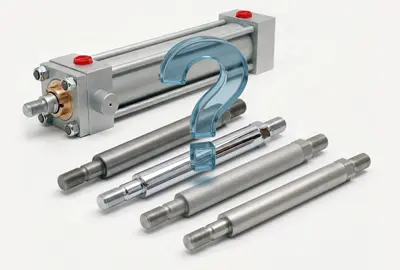
The rod is at the same time a sliding surface, a sealing surface and the most exposed part of the cylinder. It comes out of the head at every cycle and is in direct contact with the machine environment. Preserving the integrity of its surface therefore means preserving the cylinder’s sealing. That is why the catalogue offers dedicated versions “for special requirements in terms of resistance to corrosion, mechanical stress and wear”: three distinct requirements, each with a tailored solution. On Conforti hydraulic cylinders the rod is always made of ground, chrome-plated steel, which reduces seal wear and maintains sealing over time. The standard is chrome-plated CK45 on the ISO 6020/2 series and chrome-plated quenched and tempered steel on the ISO 6022 DP series. The alternatives available in the catalogue are quenched and tempered, hardened, chrome-plated stainless steel and Nikrom. Each material meets a specific requirement: impulsive loads, wear, impacts or corrosion. Choosing the rod starts with understanding which requirement needs to be met.
Chrome-plated CK45 steel: the standard
This is the standard version for CD/DK/MD tie-rod cylinders, HD/HK bolted-flange cylinders and TD/TK and TH/TX servo cylinders. It offers excellent all-round performance and is the best choice for most applications where there are no special requirements.
Chrome-plated quenched and tempered steel (RRB): impulsive loads
Quenched and tempered steel offers greater strength in applications where end-of-stroke impacts and impulsive forces are part of the duty cycle. It is available as an option on the ISO 6020/2 series and is already standard on the ISO 6022 DP series.
Chrome-plated hardened steel (RRH): resistance to wear and surface damage
A surface-hardened rod is the answer for environments where the surface may be exposed to wear and damage, such as foundries, sandblasting and shot-blasting machines.
Nikrom-coated steel (RRK): corrosion resistance of the sliding surface
In the presence of aggressive agents, Nikrom ensures a longer service life.
Chrome-plated stainless steel (RRX): full corrosion resistance
This version is designed for corrosive environments, salt spray and washdowns with acid detergents. It can be combined with nickel plating of the external surface of tie-rod cylinders, for complete protection of every part of the cylinder.
Corrosion: two levels of protection for every requirement
Corrosion protection on a hydraulic cylinder works on two levels. The first concerns the rod only: it is the right choice when the attack affects the rod while the rest of the cylinder is not exposed. The second level protects the whole cylinder. When detergents, chemicals or salt spray reach the entire cylinder, as in food industry washdowns, you need the version with nickel-plated cylinder and chrome-plated stainless steel rod: 20 µm nickel, 1200 hours in salt spray with rating 10, with the same dimensions as the ISO 6020/2 tie-rod series. It is an alternative to a cylinder made entirely of stainless steel. Specifying a stainless steel rod when the problem is the cylinder body leaves exactly the point you wanted to protect uncovered.
Material code | Rod material | Problem addressed | Availability by series |
- | Chrome-plated CK45 steel | General applications | Standard on ISO 6020/2 series |
RRB | Chrome-plated quenched and tempered steel | Impulsive loads | Option on ISO 6020/2 series Standard on ISO 6022 series |
RRH | Chrome-plated hardened steel | High surface wear and risk of damage from impacts with external bodies | Option on ISO 6020/2 and ISO 6022 series |
RRK | Nikrom-coated steel | Aggressive agents in contact with the rod sliding surface | Option on ISO 6020/2 and ISO 6022 series |
RRX | Chrome-plated stainless steel | Risk of rod corrosion: high humidity, salt spray, acid detergents | Option on ISO 6020/2 and ISO 6022 series Standard on nickel-plated tie-rod cylinders |
Rod material and buckling load
Buckling resistance does not depend on the material chosen, but on the rod diameter in relation to its free length. Checking the buckling load from the early stages of the design is one of the key steps for correct selection, as explained in the article on the 5 common mistakes in cylinder selection.
Specifying the rod when ordering
In the order code, the rod material is indicated by one of the following option codes: RRX (chrome-plated stainless steel), RRB (chrome-plated quenched and tempered steel), RRK (Nikrom), RRH (chrome-plated hardened steel). All four are available on the ISO 6020/2 series. On the DP series and TP servo cylinders, where quenched and tempered steel is already standard, RRX, RRK and RRH can be selected. In the configurator, the rod material is chosen from the available options.
Use cases
On lines with frequent washdowns using corrosive detergents, or in plants exposed to salt air, the priority is corrosion protection. If only the rod is exposed, the choice is a chrome-plated stainless steel rod. If detergents reach the whole cylinder, the choice is a nickel-plated cylinder with stainless steel rod. In foundries, sandblasting and shot-blasting machines the goal is abrasion resistance, with a hardened rod. On presses, moulding machines and rolling mills, large masses are handled under demanding conditions and resistance to impulsive loads is what counts. That is why the heavy-duty DP series comes with a chrome-plated quenched and tempered rod as standard.